


Choose Your Own Adventure: How much will effectuated enrollment drop this year?
Sat, 01/31/2026 - 11:22am
A few weeks ago, I tore apart an absurdly misleading Wall St. Journal editorial which grossly misinterpreted the then-ongoing 2026 ACA Open Enrollment Period data to falsely claim that the negative impact of the enhanced ACA tax credits expiring was far less severe than predicted.
After calling them out for some sloppy summary numbers which understated the enrollment drop by over 144,000 people out of the gate, I delved into the meat of their false argument:
...the above is fairly minor compared to the most egregiously misleading claim in the WSJ piece, which appears in the next paragraph:
The Congressional Budget Office’s ObamaCare baseline in 2024 assumed 18.9 million people would enroll in plans this year if the enhanced subsidies vanished.
Let's take a look at that CBO "baseline," shall we?
On the surface it looks legit: As of July 2024, the CBO projected that ACA Marketplace Enrollment (both subsidized & unsubsidized combined) would indeed be around 18.9 million people in 2026.
HOWEVER, there's an extremely important footnote regarding what that 18.9 million figure refers to:
The estimates in this table underlie CBO’s June 2024 baseline projections of net federal subsidies for the premium tax credit and related spending. Estimates are for average monthly enrollment over the course of a year and include spouses and dependents covered under family policies.
Average monthly enrollment over the course of a year.
In other words, the CBO didn't say that they only expected 18.9 million people to select plans during the 2026 Open Enrollment Period.
What they said is that they expect the average monthly enrollment over the full 12-month period of 2026 to be around 18.9 million people.
I went on to point out that not only are there always some people who never have their enrollment effectuated in the first place due to either the policyholder actively cancelling their policy before it even begins or having it terminated by the carrier due to them not paying their first monthly premium, but that effectuated enrollment can vary widely from month to month due to the "churn" of people either starting or ending exchange coverage.
Each month, some people newly enroll in ACA policies by qualifying for a Special Enrollment Periods (SEP) if they lose their existing coverage, get married/divorce, give birth/adopt a child, turn 26, lose Medicaid eligibility and so on. At the same time, each month other current enrollees drop their policies for a variety of reasons...and in 2026 specifically, I expect the biggest reason by far will be no longer being able to afford to pay their premiums.
As I laid out 3 weeks ago, here's a table breaking out the monthly effectuated enrollment for every year dating back to the first Open Enrollment Period (OEP) in 2013-2014:
- 2014 and 2015 data is spotty as the CMS (the Centers for Medicare & Medicaid Services) was a bit scattershot about reporting data the first two years
- January 2016 - July 2025: Hard data for every month is available via the CMS website
- August - October 2025: Rounded-off effectuated enrollment is included in the monthly Medicaid/CHIP enrollment reports
- November/December 2025: I made an educated guess
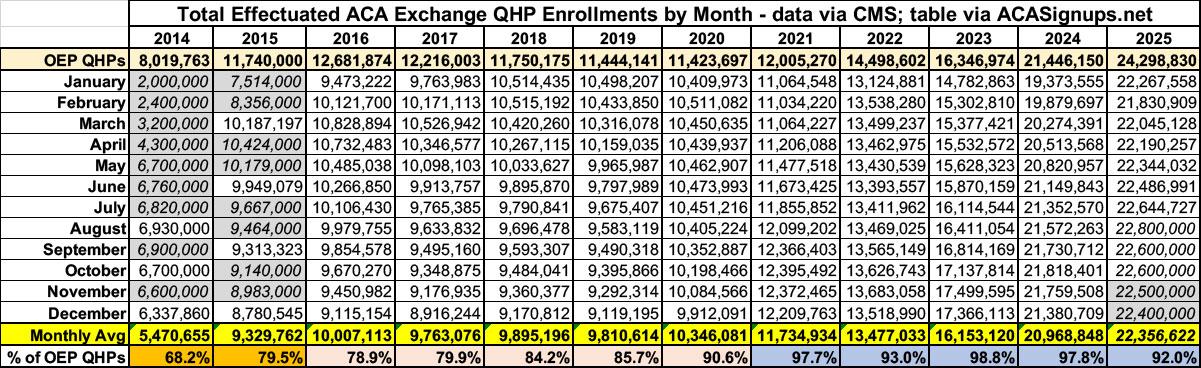
Not only has the average monthly effectuated enrollment varied widely over the years, it's also varied as a percent of total plan selections during the annual Open Enrollment Period.
Distregarding 2014 & 2015, when the ACA exchanges were still establishing themselves and the monthly effectuation data was spotty, prior years fall into two categories: 2016 - 2020, when the original premium tax credit formula was used, and 2021 - 2025, when enhanced premium tax credits (ePTC) were in place.
During the pre-ePTC years, average effectuated enrollments were clustered right around the ~10.0 million mark ranging from ~9.8 - ~10.3 million each year.
During the ePTC years, average effectuated enrollment has grown dramatically each year, from ~11.7 million in 2021 all the way up to ~22.4 million in 2025.
Here's what this looks like visually, with 2026 OEP plan selections coming in at just a hair over 23.0 million (see the white oval on the left):
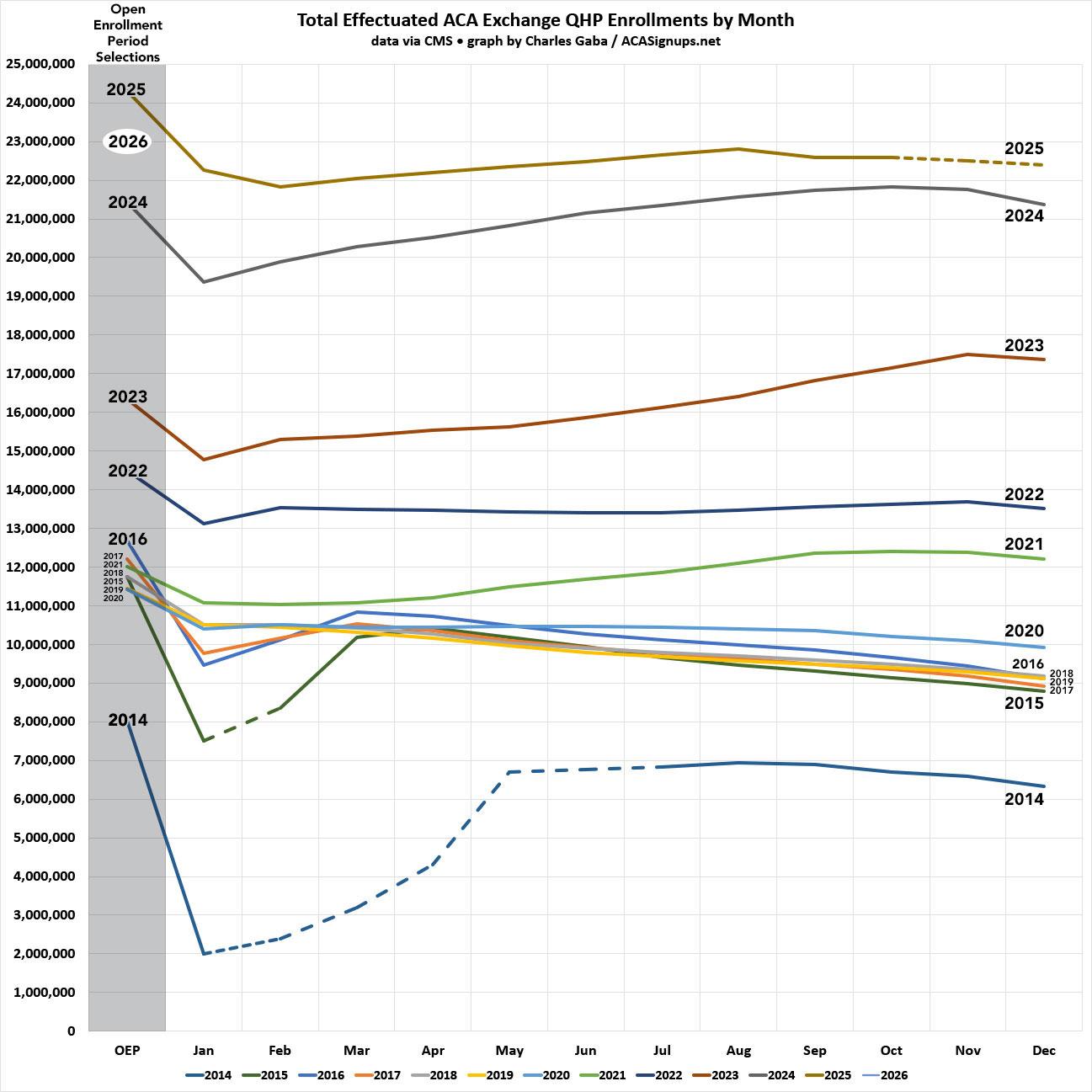
So, what does this mean for monthly effectuated enrollment this year? Well, it's pretty safe to say that it's not going to look anything like the ePTC years; in fact, at least a half-dozen state-based ACA exchanges have posted press releases warning that they're already seeing record levels of plan cancellations.
Instead, it seems pretty clear that the pattern is much more likely to resemble one of the NON-ePTC years. Here's what it would look like if effectuations in 2026 follow the exact path of those years:
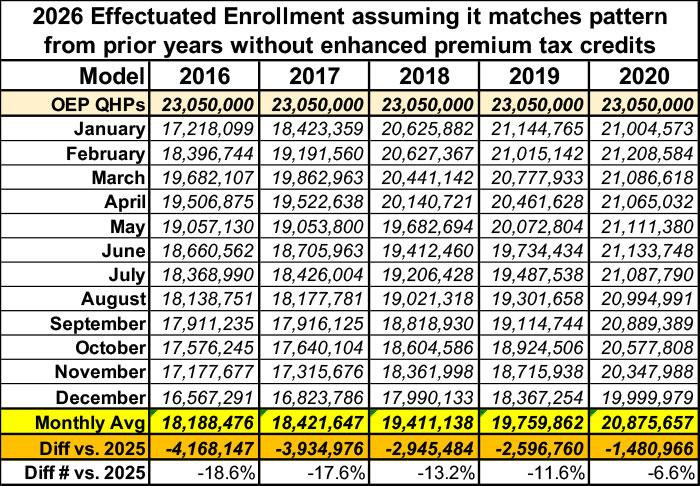
Depending on which year it mimics, average 2026 effectuations will range somewhere between 18.2 million - 20.9 million per month. If so, this would mean anywhere from 1.4 - 4.1 million fewer exchange enrollees than 2025.
Here's what that would look like visually:
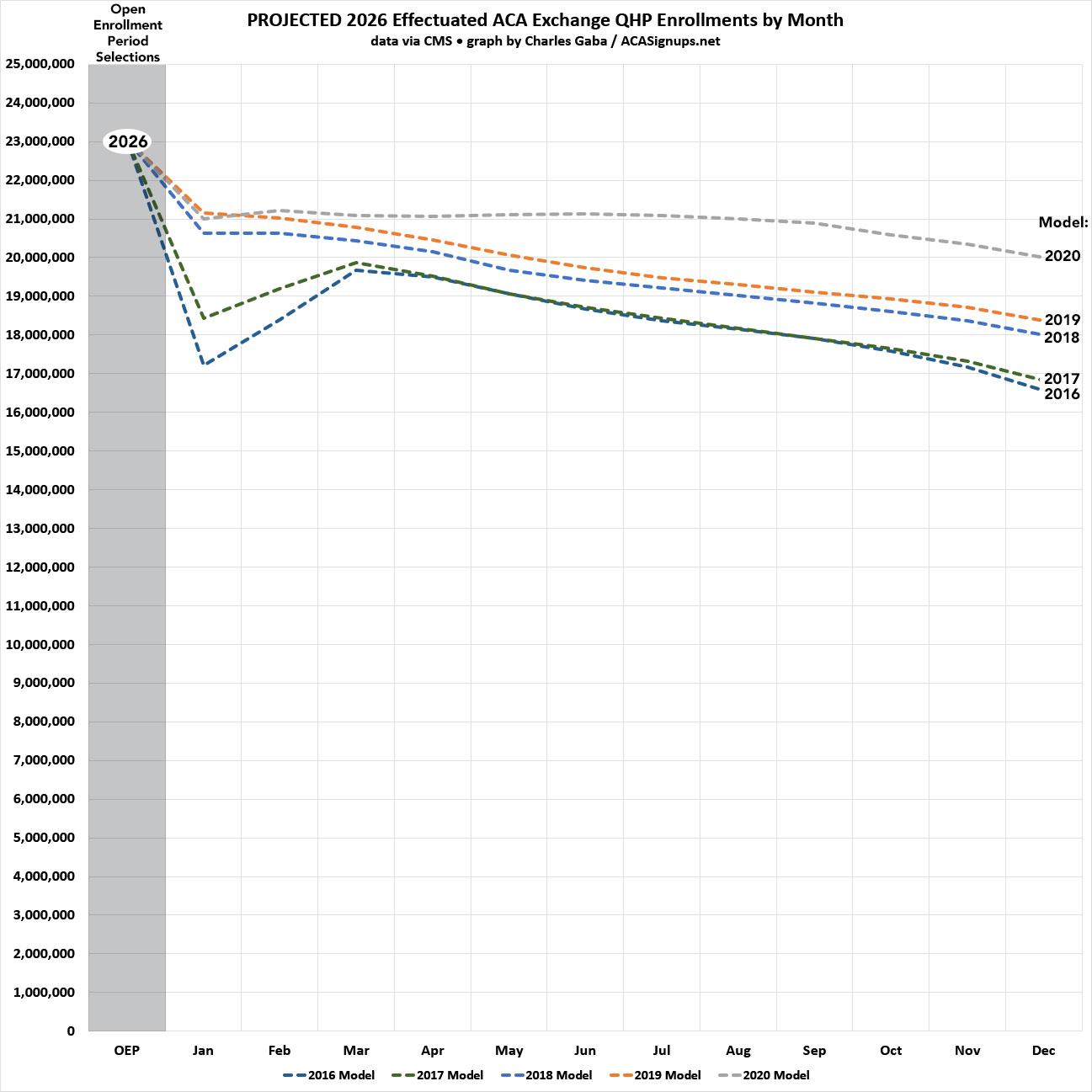
Of course it's also conceivable that the actual 2026 pattern won't resemble any of these; it could be higher or lower. Personally, I suspect it will be lower, with a steeper drop-off in the first quarter of the year, followed by more gradual attrition as the rest of 2026 passes by.
Again, assuming CMS follows prior years...
- The final 2026 Open Enrollment Period report won't be published until late April/early May
- EFFECTUATED enrollment data for the first few months of 2026 won't be published until sometime in July
- AVERAGE MONTHLY effectuated enrollment data for the full year of 2026 won't be known until sometime in 2027.
Stay tuned...
How to support my healthcare wonkery:
1. Donate via ActBlue or PayPal
2. Subscribe via Substack.
3. Subscribe via Patreon.
Advertisement


