


Final 2026 Open Enrollment Report: Household Income (100 - 200% FPL) (updated)
Thu, 04/09/2026 - 4:04pm
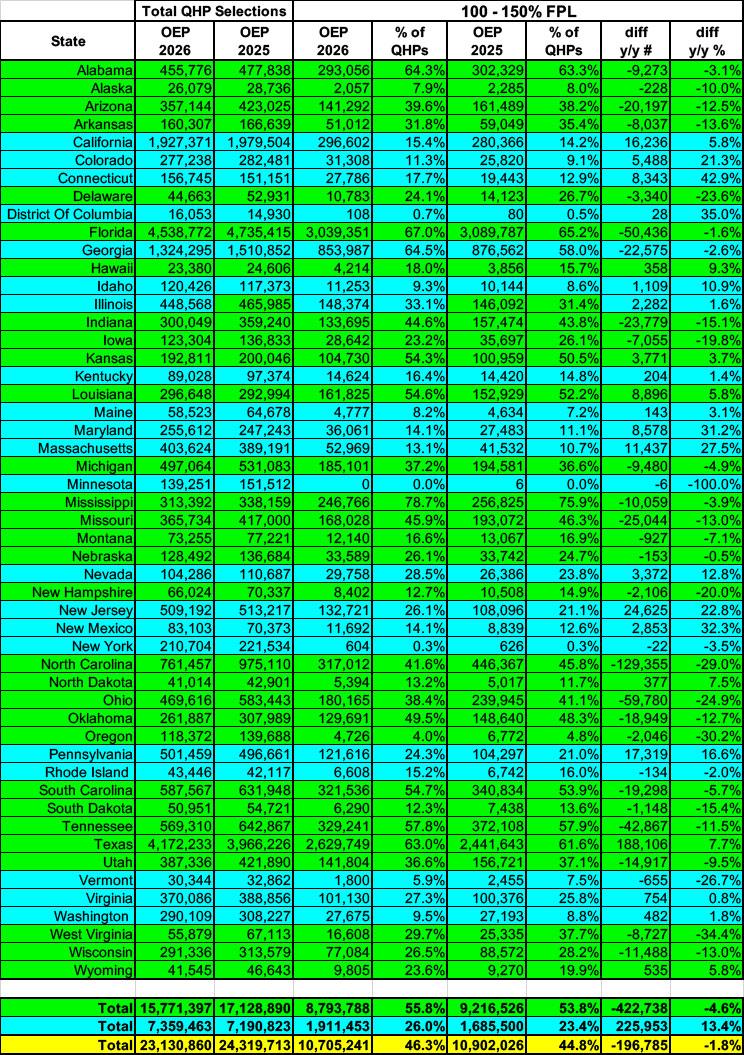
Turning to the 100 - 200% FPL range, 64% of all exchange enrollees fall into this income range (up slightly from 63% last year).
That's ~14.8 million people total, with ~10.7 million earning 100 - 150% FPL and the remaining ~4.1 million earning 150 - 200% FPL.
The vast majority of those in the first bracket (and most of those in the second) should be enrolled in Silver plans since they're eligible for generous CSR assistance which boosts Silver plans up to "Secret Platinum" status: If they earn up to 150% FPL Silver plans have a 94% Actuarial Value; if they earn 150 - 200% FPL Silver is boosted to 87% AV.
In layman's terms, High CSR Silver plans have either free or extremely low premiums along with extremely low deductibles & co-pays.
Unfortunately, only 9.85 million enrollees chose Silver this year...and even then, not all of them are in the 100 - 200% FPL range, which means there's quite a few who left hundreds or thousands of dollars in financial assistance for out of pocket costs on the table...except that with the enhanced federal tax credits having expired, many of these folks may have had no choice due to the increase in their premiums.
Put another way, getting a Ferrari for the price of an Audi doesn't do you much good if all you can afford is a Sentra.

In the 100 - 150% FPL range, nearly 200,000 people lost coverage...and considering that just yesterday I noted that enrollment in the 100 - 138% FPL range increased by ~325,000 people, that means enrollment from 138 - 150% FPL dropped by a stunning 522,000 enrollees!
I don't know how many of these folks actually dropped coverage vs. how many of them saw their incomes drop below the 138% threshold, although breaking it out between Medicaid expansion & non-expansion states should lend some insight:
- In NON-expansion states, enrollment from 100 - 138% increased by ~342,000 while enrollment from 138 - 150% dropped by ~316,000.
- In EXPANSION states, enrollment from 100 - 138% dropped by ~16,000 while enrollment from 138 - 150% dropped by ~207,000.
This suggests to me that a big part of what happened here is that several hundred thousand people saw their incomes drop below 138% FPL: In expansion states, they shifted over to Medicaid (thus disappearing from the ACA exchange tally entirely) while in non-expansion states they remained enrolled in ACA plans, just in the 100 - 138% bracket.
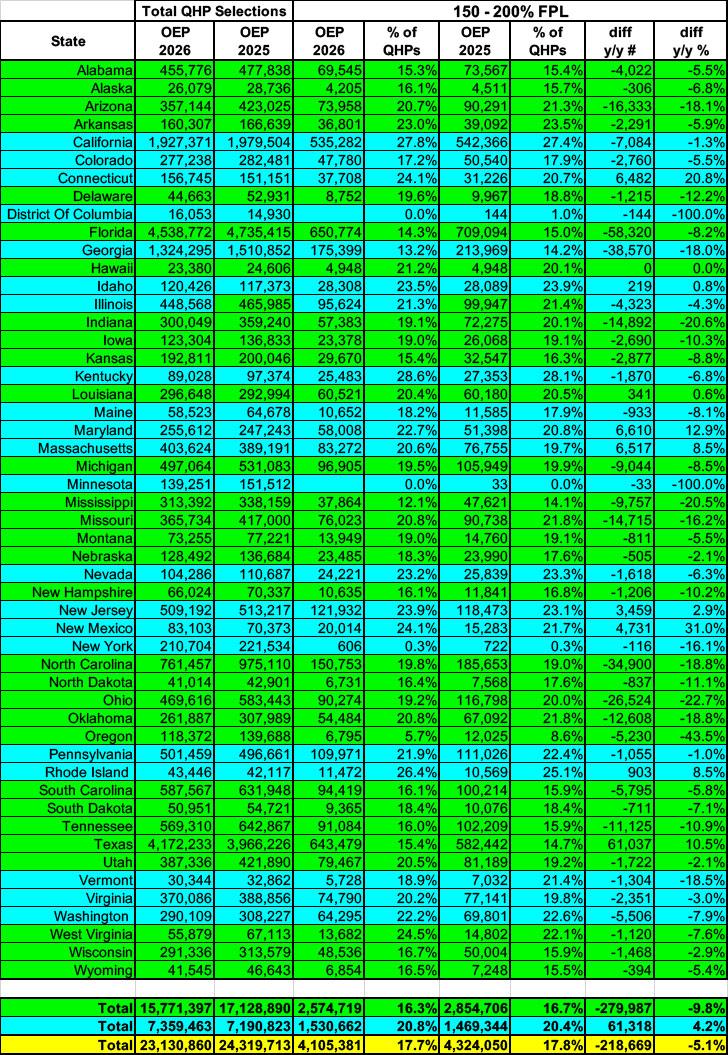
Enrollment from the 150 - 200% FPL range also dropped by over 218,000 people, or around 5.1% nationally.
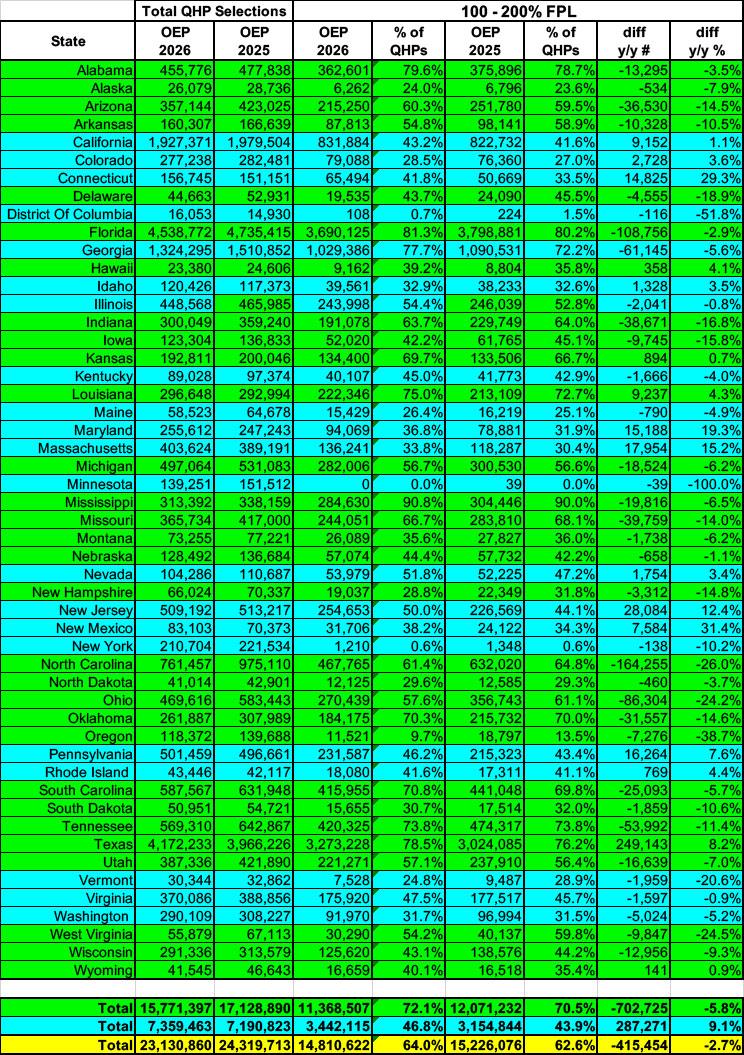
Combined, enrollment in the 100 - 200% FPL range dropped by over 415,000 people, or 2.7% nationally, although there are 16 states where it actually increased, and 5 states (all blue, all operating their own exchanges) where it increased by double digits:
- New Jersey: +12.4%
- Massachusetts: +15.2%
- Maryland: +19.3%
- Connecticut: +29.3%
- New Mexico: +31.4%
On the other hand, setting aside Minnesota & DC (which had nominal enrollment below 200% to begin with due to their BHP programs) and Oregon (which is a special case as they appear to still be in the process of phasing in their BHP program even though it's been in effect since July 2024), there's also several states which saw 100 - 200% FPL enrollment drop by 20% or higher, including North Carolina, West Virginia, Ohio and Vermont.
When I further break this data out by metal level, a couple of other important things become clear as well.
Earlier this week I noted that Gold enrollment increased by around 770,000 people, but that this isn't necessarily a good thing since some of those who moved to Gold were likely coming from a high-CSR Silver plan, which means they actually downgraded their coverage. My friend Andrew Sprung took this one step further by stating that...
...the shift to gold is not an upgrade in actuarial terms. MORE than all of it is at incomes below 200% FPL. Gold enrollment went down at incomes over 200% FPL. Year-over-year, increased gold selection *reduced* average AV -- though it probably kept some low-income enrollees from switching to bronze or dropping out altogether.
Sure enough, from 2025 to 2026, nationally:
- Gold enrollment increased by over 1.0 million people among enrollees earning less than 200% FPL.
- Gold enrollment decreased by nearly 300,000 people among enrollees earning more than 200% FPL.
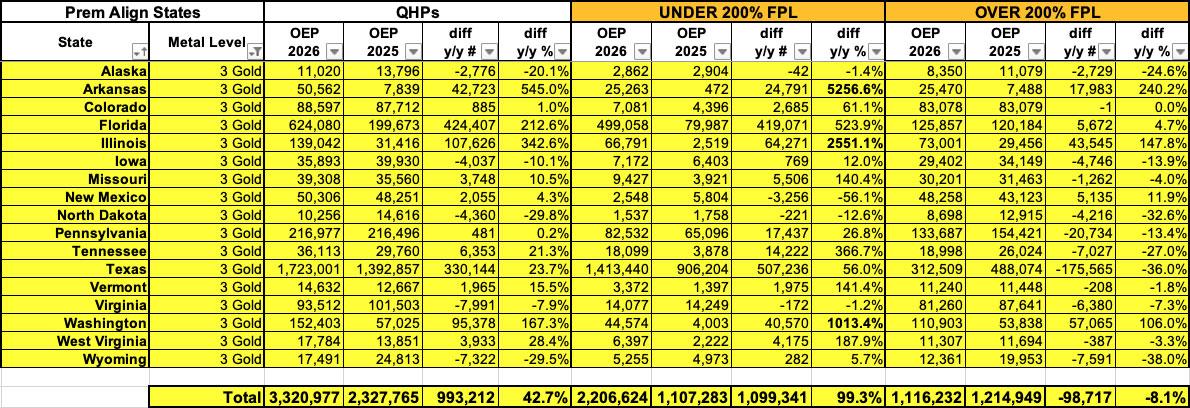
OK, but what about the Premium Alignment factor? Well, here's how that breaks out.
- In the 17 Premium Alignment states, Gold enrollment nearly doubled below 200% FPL, skyrocketing by over 1.1 million people. Over 200% FPL it dropped by ~8% or around 98,000.
- In the remaining 34 states, Gold enrollment dropped by 22% year over year under 200% FPL...and dropped by 26% over 200% FPL.
Update 4/11/26: I had Arkansas in the wrong table below; both have been corrected, as have the bullets above, which only makes my point stronger. In addition, notice how in Arkansas, Illinois & Washington State (the three states which newly-implemented Premium Alignment policies this year), Gold enrollment shot up at an even more dramatic rate (anywhere from 10x to 52x higher below 200% FPL). In addition, h/t to Andrew Sprung for pointing out that these are also the only states where it increased over 200% FPL to a significant degree.

I'm sure there's some other noteworthy stuff as well but I'll leave this income bracket there for now. Next up: 200 - 400% FPL.
Advertisement


