The main reason for pushing for 51 separate websites in the first place was mainly just an attempt to win over a few conservative "states rights" votes in Congress from Republicans and some conservative Democrats. There were some practical advantages to doing it this way as well (potential innovations from trying things different ways, plus a few states like Vermont and Massachusetts wanted to offer additional financial assistance beyond the normal tax credits/cost sharing provisions, and Hawaii already has an existing state law which is actually better than some of the provisions included via the federal exchange)...but on the whole, the sheer economy of scale advantages of one federal site make the downsides seem pretty small in comparison for most states.
Earlier this week the New Jersey Dept. of Banking & Insurance put out a press release with the final 2026 ACA Open Enrollment Period data for the state:
Enrollment Expected to Decline As Federal Changes Continue to Impact Affordability
TRENTON —More than 509,000 New Jersey residents enrolled in health insurance coverage for 2026 through Get Covered New Jersey, the state’s Official Health Insurance Marketplace, during the Open Enrollment Period. However, the state is cautioning that the full effect of the loss of federal subsidies has not impacted the marketplace yet and is predicting a material drop off in enrollment this Spring.
Today at the White House, Vice President J.D. Vance, Secretary of Health and Human Services (HHS) Robert F. Kennedy, Jr., and Administrator of the Centers for Medicare & Medicaid Services (CMS) Dr. Mehmet Oz announced new steps to crack down on fraud in Medicare and Medicaid to protect patients and taxpayers and improve affordability. The actions include deferring $259.5 million of quarterly federal Medicaid funding in Minnesota to prevent payment of questionable claims while further investigation is completed; a nationwide moratorium on Medicare enrollment for certain Durable Medical Equipment, Prosthetics, Orthotics, and Supplies (DMEPOS) suppliers; and a nationwide call to action for Americans to support fraud prevention, including stakeholder input on how CMS can continue to expand and strengthen its efforts.
Whether the data posted since January 20, 2025 is accurate or not, I can't say for certain, but at least they're updating it...and so far, at least, I don't see anything in their monthly reports which is setting off any obvious red flags.
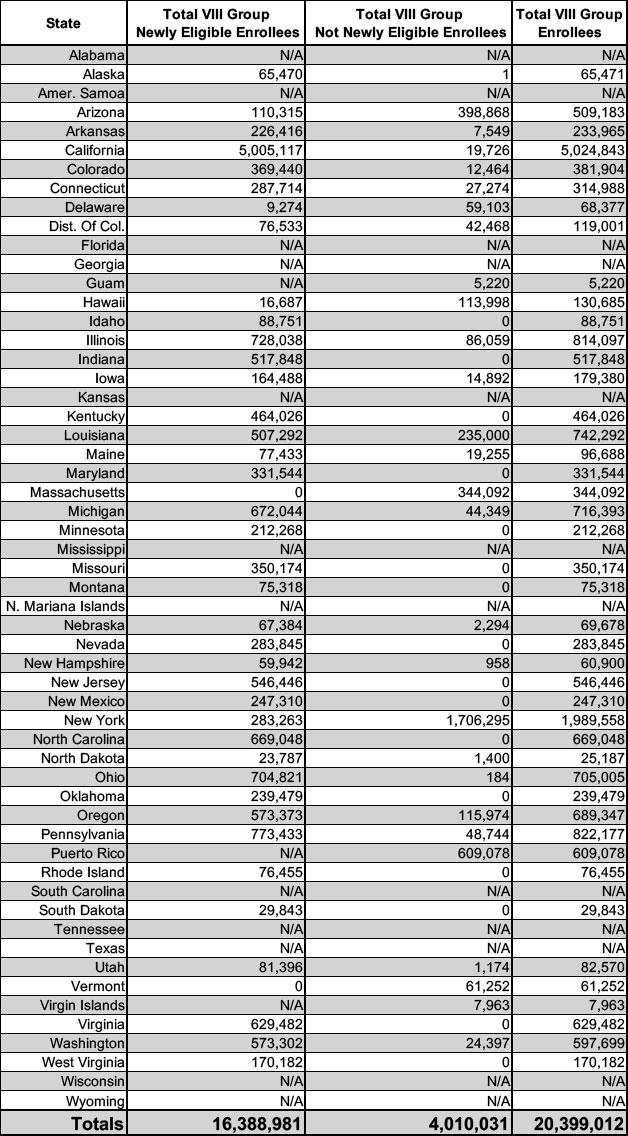
In any event, according to the latest report, as of November 2025:
Expanded outreach and new financial assistance helped keep residents covered
HARTFORD, Conn. (Feb. 19, 2026) — Access Health CT (AHCT), Connecticut’s official health insurance marketplace, today announced a record number of Connecticut residents enrolled in health and dental insurance during the 2026 Open Enrollment Period, which began Nov. 1, 2025 and ended Jan. 31, 2026. This is the third year in a row AHCT has seen record-breaking enrollment.
A total of 157,246 people enrolled in a Qualified Health Plan (QHP) during the 2026 Open Enrollment Period, compared to 151,151 at the end of the Open Enrollment Period in 2025. This year’s enrollment broke last year’s record by 4%.
Included in that number are 51,629 residents enrolled in the Covered CT Program, compared to 41,165 during the Open Enrollment Period last year. Covered CT provides no-cost coverage for eligible residents. The State of Connecticut pays the consumer portion of premiums and cost-sharing.
It may not make any difference but believe it or not sometimes it does, even under the Trump regime...and in fact in some cases they're actively stating that they're seeking comment as opposed to just ramming the proposed changes through.
The Patient Protection & Affordable Care Act includes a long list of codified instructions about what's required under the law. However, like any major piece of legislation, many of the specific details are left up to the agency responsible for implementing the law.
It may not make any difference but believe it or not sometimes it does, even under the Trump regime...and in fact in some cases they're actively stating that they're seeking comment as opposed to just ramming the proposed changes through.
The Patient Protection & Affordable Care Act includes a long list of codified instructions about what's required under the law. However, like any major piece of legislation, many of the specific details are left up to the agency responsible for implementing the law.
UPDATE: Someone correctly pointed out that it’s a bit unfair to tell people to “be afraid” without giving them any action items to try and stave off the uglier changes being proposed. You have until March 13th to submit a comment to CMS. It may not make any difference but believe it or not sometimes it does, even under the Trump regime.
The Patient Protection & Affordable Care Act includes a long list of codified instructions about what's required under the law. However, like any major piece of legislation, many of the specific details are left up to the agency responsible for implementing the law.
WASHINGTON — The U.S. Department of Health and Human Services (HHS) announced today it is implementing important measures to expand access to more affordable catastrophic health coverage through HHS’ new hardship exemption guidance. This guidance streamlines access to more affordable catastrophic coverage for consumers who are ineligible for advance payments of the premium tax credit (APTC) or cost-sharing reductions (CSRs).
Through these efforts, more Americans will be able to qualify for catastrophic health coverage based on need, beginning November 1st with the start of open enrollment.
Let's stop a moment and look at what Catastrophic Plans actually are.
Key Insurers Expect To Lose Nearly 3M Combined ACA Enrollee By End Of 2026
Key publicly traded insurers reported in recent earnings calls that they expect to lose nearly 3 million enrollees combined by the end of 2026, buoying stakeholders’ fear that the loss of the enhanced tax credits will drive more people from the marketplace than the 1 million fewer signups reported by CMS
While CMS’ mid-January snapshot showed that about 1 million fewer people enrolled in an Affordable Care Act plan during open enrollment compared to last year, insurers in recent earnings calls are echoing state exchange officials’ belief that true results will take time, and four large companies reveal they expect at least 2.8 million fewer ACA exchange consumers.
Also, in line with comments from state exchange officials, carriers are seeing more consumers enrolled in less-expensive bronze plans, which have higher co-pays and deductibles.
OLYMPIA, Wash. – More than 290,000 Washingtonians selected a plan...
...40,000 fewer Washingtonians are receiving premium tax credits in 2026 than 2025. Some customers saw significant increases in their health insurance premiums, resulting in more than 61,000 customers changing their plans.
Customers also canceled their coverage more than any year prior — more than 28,000 in 2026 compared to just over 20,000 in 2025. Based on higher costs, it is expected that even more customers will disenroll before final counts are published in spring.
...Preliminary numbers show that more than 119,000 Washingtonians are receiving Cascade Care Savings and more than 188,000 are receiving federal premium tax credits.
One in Five Pennie Enrollees Drop Health Coverage Due to Expired Federal Tax Credits
High demand seen for quality affordable coverage during Open Enrollment Period.
Harrisburg, PA – Pennie, Pennsylvania’s official health insurance marketplace, concluded its 2026 Open Enrollment Period with enrollment totaling around 486,000 and with adverse effects from unprecedented cost increases. A doubling of premium costs caused around 85,000 Pennsylvanians to drop coverage, meaning that nearly 1 in 5 enrollees were unable to keep their health plan for 2026.
CoverME.gov is Maine's state-based health insurance marketplace, administered by the Maine Department of Health and Human Services' Office of the Health Insurance Marketplace. The 2026 Open Enrollment period recently ended, during which individuals and families were able to compare and enroll in private health insurance plans and determine eligibility for financial assistance.
Preliminary data from the 2026 Open Enrollment period indicate several emerging trends in Maine's individual health insurance market. While many Mainers enrolled in coverage through CoverME.gov, early indicators point to declining enrollment and increased affordability pressures that may affect coverage stability for consumers and the broader health insurance system.
OZ: We have seen in the ACA marketplace where there was a baseline 83 percent subsidy, that, when you take away the extra 5 percent, which is what the enhanced premium subsidies represent, it doesn't really affect enrollment.
In fact, we're still roughly at around 23, 24 million people. And that's despite the fact that all the fearmongers were saying, we're going to lose eight, 10, 12 million people. No one seems to have left the exchange.
According to the new report, total enrollment from December 2024 through June 2025 dropped by 517,000 people, or roughly 2.5%, standing at 20.4 million nationally as of last June, so it doesn't look like the Trump Admin has started cooking these particular books, at least not yet.
Limited-time marketplace transition year Special Enrollment Period
This year, with the multitude of unique factors impacting access and affordability, Get Covered Illinois is using its authority as a state-based marketplace to offer a limited-time Special Enrollment Period for customers previously enrolled in a 2025 health plan through HealthCare.gov.
Who Qualifies for this Special Enrollment Period?
To qualify for this limited-time Special Enrollment Period, the enrollee must:
have been automatically renewed in a 2026 health plan through Get Covered Illinois, and
have not made an active plan selection or terminated/canceled their coverage during this past Open Enrollment Period, and
have not claimed their Get Covered Illinois account by February 1, 2026.
How long is this Special Enrollment Period available?
Back in December, I issued a strong warning that the official 2026 ACA Open Enrollment Period data would have to be taken with a huge grain of salt, since the actual effectuated enrollment data would likely take much longer to know:
...I'm bringing all of this back up again today because I strongly suspect that the situation is about to reverse itself, with the Trump Administration already preparing to brag about impressive-sounding ACA enrollment numbers for 2026 in spite of the enhanced tax credits expiring less than 60 hours from now...even though the actual negative impact of the expiring tax credits (along with several other administrative policy changes made by CMS this year) likely won't be known for several months after Open Enrollment officially ends in January.
Top Senate negotiators said an effort to renew expired healthcare subsidies had effectively collapsed, likely ending the hopes of 20 million Americans that the tax-credit expansion could be revived and lower their monthly insurance premiums.
Talks had centered on a proposal from Sens. Bernie Moreno (R., Ohio) and Susan Collins (R., Maine) to extend a version of the enlarged Affordable Care Act subsidies for at least two years, while cutting off higher-income people from participating and eventually giving enrollees the option of putting money into health savings accounts. It also would eliminate zero-dollar premium plans. But lawmakers from both parties now say the chances of a deal have all but evaporated.
“It’s effectively over,” Moreno said Wednesday. Sen. Bill Cassidy (R., La.)—the architect of an adjacent plan—agreed. While Collins declined to be as definitive, she did say that it was “certainly difficult.”
The Maryland Health Benefit Exchange has their own Open Enrollment dashboard which, while not providing nearly as much data as New Mexico's, at least breaks out the top-line data. With the 2026 Open Enrollment Period (OEP) now over in the Old Line State, here's what their final numbers look like (barring any last-minute clerical corrections):
Total Renewals: 236,338
New Enrollees: 47,815
Total Enrollments: 255,612
Disenrollments (already subtracted from renewals)
67.4% are subsidized; 32.6% are unsubsidized
They also break out total enrollment by county, which isn't terribly relevant to me.
Final 2025 OEP enrollment in Maryland was 247,243, so this represents a 3.4% QHP selection increase vs. last year, in spite of the enhanced federal tax credits expiring...
MNsure, Minnesota's state-based ACA exchange, has posted their January Board Directors Meeting presentation, which includes the final 2026 Open Enrollment Period tally along with a bunch of other data points of interest:
Plan Year 2025 (November 1, 2024 – December 31, 2025)
Total (Medical Assistance, MinnesotaCare, QHP) 357,227
The 2026 ACA Open Enrollment Period is now officially over in every state.
For most Americans, if you missed the deadline to enroll in ACA exchange healthcare coverage, your options are pretty limited at this point...but there are some exceptions, so let's take a look.