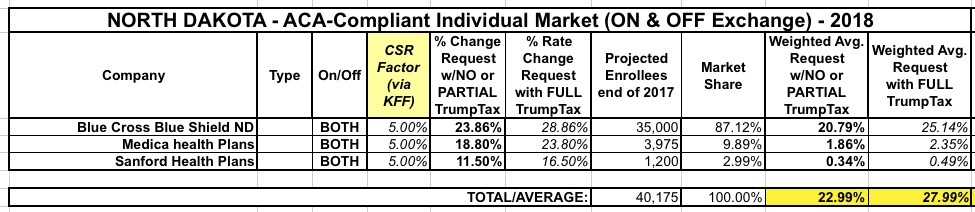
Unfortunately, North Dakota is another state where the carriers have redacted their rate filings. I was able to garner some info about one of the three carriers participating in the Individual Market next year: Medica's filing redaction wasn't done properly, so I was able to extract that they're looking at medical trend of 7.7%, a morbidity reduction of 1.5%, a 2.3% increase due to the reinstatement of the ACA's insurer fee...and a 20% reduction due to the implementation of the state's reinsurance program, which I first reported on last fall and followed up with this spring.
Last September I noted that North Dakota was considering going one of two ways when it comes to making a major change in their individual insurance market: EIther joining over a half-dozen other states in pushing for a reinsurance program (which I strongly support doing), or going the other way and starting to offer weaker policies without some ACA protections the way states like Idaho, Tennessee, Iowa and Kansas either already do or are in the process of doing.
A few minutes ago I posted about North Dakota'sapproved 2019 rate hikes, which are coming in at a mere 3.2% on average (but which would likely be dropping nearly 20 points without both last and this year's #ACASabotage factors).
As I noted last month when I first analyzed the requested 2019 rates for North Dakota insurers, ND was somewhat unique last year in that it was one of only two states (the other was Vermont) which didn't tack on any extra premium increases for 2018 to account for the lost Cost Sharing Reduction reimbursement revenue after Donald Trump cut off those payments last October.
This led to one of North Dakota's three carriers, Medica, dropping off the ACA exchange altogether, though they still ended up enrolling a few hundred people directly via the off-exchange market.
In direct response to this, Medica Health Plans dropped out of the ND on-exchange individual market this year to avoid taking the CSR hit. They hung around the off-exchange market, however, and therefore still have about 600 enrollees in the state.
20 states went the full #SilverSwitcharoo route (the best option, since it maximizes tax credits for those eligible for them while minimizing the number of unsubsidized enrollees who get hit with the extra CSR load);
16 states went with partial #SilverLoading (the second best option: Subsidized enrollees get bonus assistance, though not as much as in Switch states; more unsubsidized enrollees take the hit, but they aren't hit quite as hard);
6 states went with "Broad Loading", the worst option because everyone gets hit with at least part of the CSR load except for subsidized Silver enrollees;
6 states took a "Mixed" strategy...which is to say, no particular strategy whatsover. The state insurance dept. left it up to each carrier to decide how to handle the CSR issue, and ended up with a hodge podge of the other three
3 states (well, 2 states + DC, anyway) didn't allow CSR costs to be loaded at all. Their carriers have to eat the loss, which makes little sense, but what're ya gonna do?
Medica Leaving North Dakota Individual Health Insurance Exchange in 2018
Post date: Sep 28, 2017
BISMARCK, N.D. – Insurance Commissioner Jon Godfread today confirmed that the Insurance Department was informed late Wednesday, Sept. 27, that Medica does not intend to sign an agreement with the federal government to offer coverage on the Affordable Care Act (ACA) Exchange for their individual health insurance in North Dakota for 2018.
“We have had numerous conversations with Medica over the course of the past few months, and given the uncertainty that currently exists around cost sharing reductions, they are unable to move forward in the Federal Exchange,” Godfread said.
In August I wrote that the situation in North Dakota was pretty straightforward: Three carriers on the individual exchange (BCBS, Medica and Sanford), requesting average rate hikes of around 24%, 19% and 12% respectively for an average increase of 23% assuming CSR payments are made, or a bit higher (28%) if they aren't.
Yesterday, however, with the final contract signing deadline having passed on the 27th, Louise Norris reports that one of the three carriers, Medica, was forced to drop out of the market at the last moment...not because they wanted to, but because the ND insurance dept. insisted on carriers pricing 2018 premiums on the assumption CSRs will be paid for the full year.
Medica understandably refused to take that risk (the odds of CSRs being guaranteed are virtually nil, and the odds of them being paid each and every month, as they're supposed to, is only so-so), so they dropped out instead.
North Dakota's numbers are pretty straightforward. Only three carriers, none of whch say anything about CSR or mandate concerns, so I have to assume that their requested rate increases are the best-case scenario. In addition, the KFF estimates suggest only a 5 point additional CSR factor anyway. This results in roughly a 23% average hike if CSRs are paid vs. a 28% increase if they aren't.
Of the 31 states which have expanded Medicaid under the Affordable Care Act, only a handful issue regular monthly or weekly enrollment reports.
I noted in February that enrollment in the ACA's Medicaid expansion program had increased by around 35,000 people across just 4 states (LA, MI, MN & PA).
It's early June now, so I checked in once more, and the numbers have continued to grow. I have the direct links for 5 states now (including New Hampshire)...