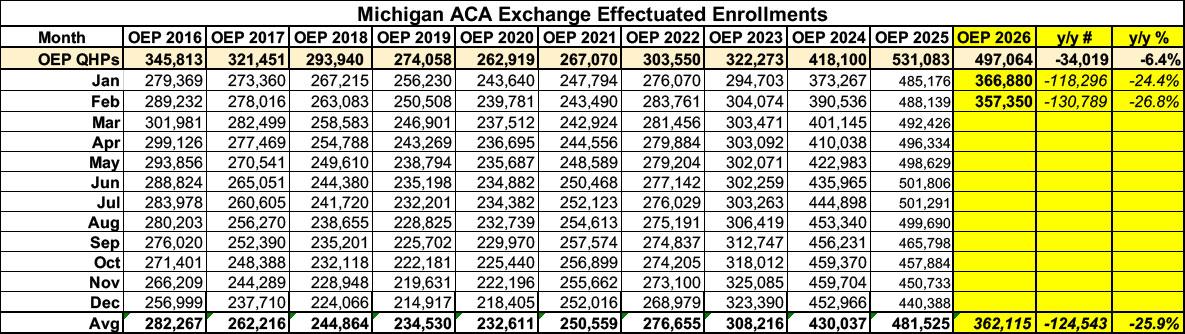
Before I begin, it's important to note that as in most states, ACA exchange enrollment has plummeted in Michigan since Congressional Republicans allowed the enhanced federal subsidies to expire at the end of last year: Effectuated enrollment was down 27% year over year as of February, and has almost certainly continued to drop further since then. That's at least 131,000 fewer Michiganders enrolled in ACA healthcare coverage this year.
Here's what this looks like visually, with both 2025 and 2019 (the last pre-COVID year, which didn't include the enhanced subsidies) included for comparison:
2027 Requested Commercial Health Insurance Rates Have Been Submitted to OHIC for Review
The Office of Health Insurance Commissioner (OHIC) today released the individual, small group, and large group market premium rates requested by Rhode Island’s insurers. The requests were filed as part of OHIC’s rate review process (for coverage effective on or after January 1, 2027).
“Health insurers are once again seeking rate increases to cover the rising cost of health care and other expenses,” said Health Insurance Commissioner Cory King. He continued: “OHIC will thoroughly review these requests to determine whether they are justified.”
Two insurers, Blue Cross Blue Shield of Rhode Island (BCBSRI) and Neighborhood Health Plan of Rhode Island (NHPRI), filed rates for plans to be sold on the individual market to people and families who do not receive insurance through their employer.
"In other words, Republicans’ insistence that they have a superior alternative to Obamacare is a zombie lie — a claim that should be dead after having been proved false again and again, but it is still shambling along, eating people’s brains."
This is perhaps the 3rd or even 4th time that I've written a post debunking this particular Republican zombie lie, but usually I've included it as part of a larger post debunking other silly claims as well. Since it's making the rounds again I figured I should write something up which addresses it standalone.
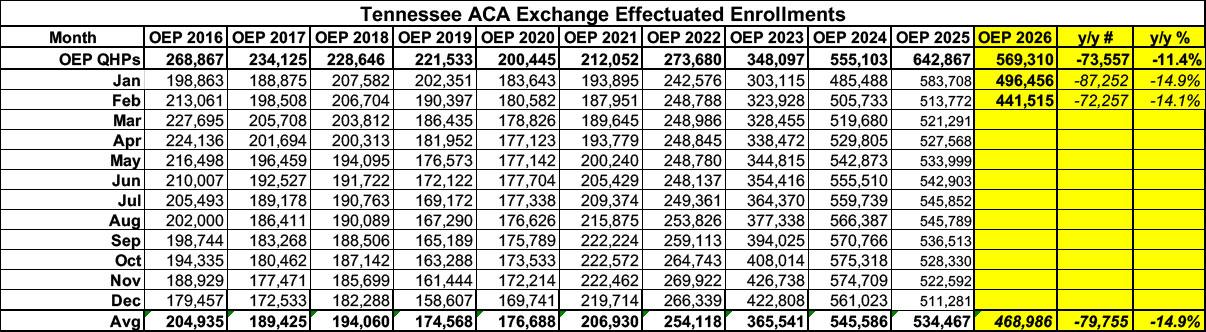
ACA exchange enrollment has dropped by over 14% in Tennessee since Congressional Republicans allowed the enhanced federal subsidies to expire at the end of last year.
Initial signups during Open Enrollment were down 11.4% vs. OEP 2025...but effectuated enrollment dropped by 14% year over year as of February.
That's over 72,000 Tennesseans who already lost coverage in just the first two months of the year...a number which has likely continued to climb since then.
Here's what this looks like visually, with both 2025 and 2019 (the last pre-COVID year, which didn't include the enhanced subsidies) included for comparison:
Health Carriers Propose Affordable Care Act Premium Rates for 2027
Proactive policies of the Moore Administration and General Assembly ensure that Maryland's individual premium rates remain among the lowest in the nation, in spite of federal pressures due to changing Exchange rules and continued lack of expansion of enhanced tax credits
BALTIMORE – The Maryland Insurance Administration has received the 2027 proposed premium rates for Affordable Care Act products offered by health and dental carriers in the individual, non-Medigap and small group markets, which impact approximately 482,000 Marylanders and represents 19% of the commercial health insurance market.
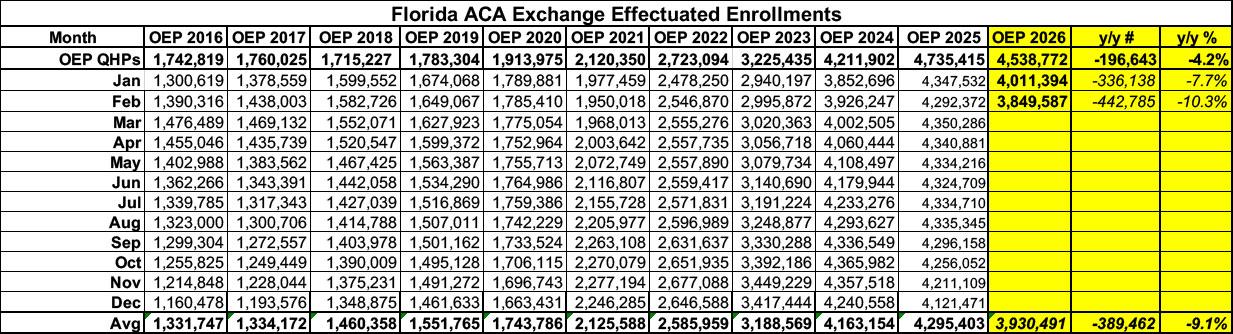
ACA exchange enrollment has dropped by more than 10% in Florida since Congressional Republicans allowed the enhanced federal subsidies to expire at the end of last year.
Initial signups during Open Enrollment were only down 4% vs. OEP 2025...but effectuated enrollment was 7.7% lower year over year in January, rising to 10.3% lower as of February.
That's over 440,000 Floridians who already lost healthcare coverage in just the first two months of the year...a number which has likely continued to climb since then.
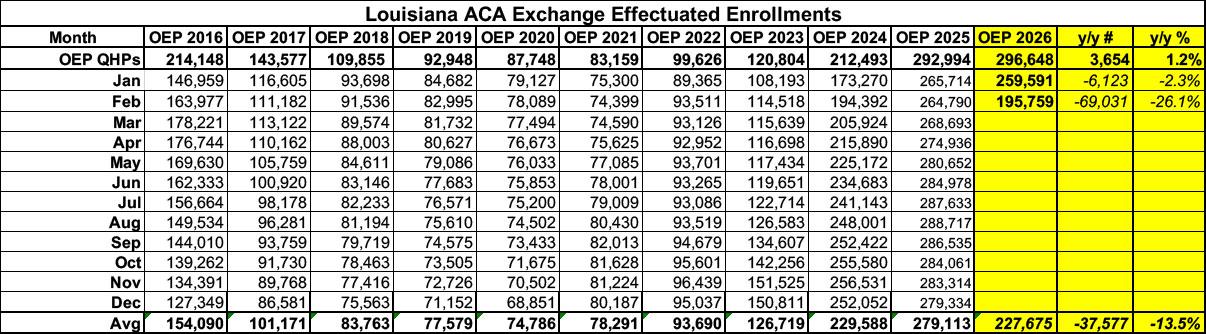
Before I begin, it's important to note that ACA exchange enrollment has plummeted in Louisiana since Congressional Republicans allowed the enhanced federal subsidies to expire at the end of last year.
Initial signups during the 2026 Open Enrollment Period were actually up slightly vs. OEP 2025...but actual effectuated enrollment was 2.3% lower as of January...and then fell off a cliff in February, with enrollment dropping a stunning 26% vs. a year earlier. That's over 69,000 Louisianans who were priced out of coverage in just the first two months of the year:
Medicare Advantage (technically "Medicare Part C" & originally called "Medicare+Choice") is a type of health plan in the United States offered by private companies as part of the original Social Security Act of 1965 that created Medicare. It permits a private insurance option that wraps around traditional Medicare. Medicare Advantage plans attempt to fill some coverage gaps and offer alternative coverage options.
Under Part C, Medicare pays a plan operator a fixed payment for each enrollee. The operator then pays for their medical expenses. Traditional Medicare directly compensates providers on a fee-for-service basis. Plans are offered by integrated health delivery systems, labor unions, non profit charities, and health insurance companies, which may limit enrollment to specific groups of people (such as union members).
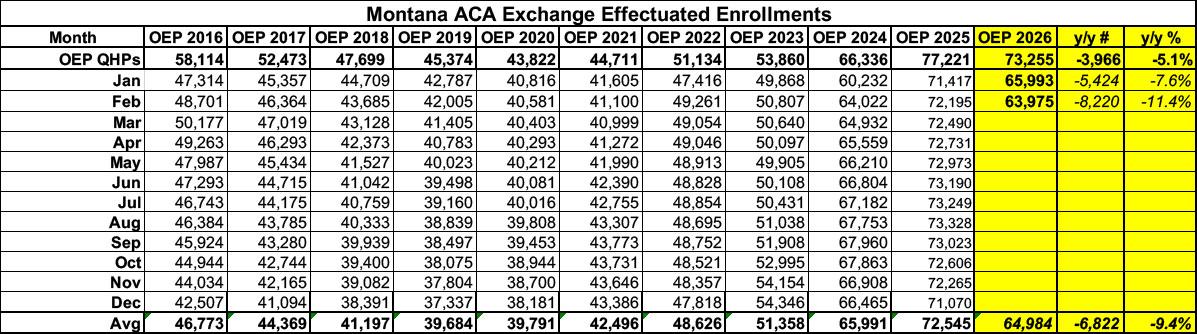
ACA exchange enrollment has dropped by more than 11% in Montana since Congressional Republicans allowed the enhanced federal subsidies to expire at the end of last year.
Initial signups during Open Enrollment were only down 5.1% vs. OEP 2025...but effectuated enrollment was 7.6% lower year over year in January, rising to 11.4% lower as of February.
The effectuated enrollment numbers have likely continued to drop more since then (the raw numbers aren't that eyebrow-raising since Montana is a small state, population-wise).
Here's what this looks like visually, with both 2025 and 2019 (the last pre-COVID year, which didn't include the enhanced subsidies) included for comparison:
(Washington, DC) – The DC Department of Insurance, Securities and Banking (DISB) has received 181 proposed health insurance plan rates for annual review in advance of open enrollment for plan year 2027. The proposed rates were submitted for DC Health Link, the District’s health insurance marketplace, from CareFirst BlueCross BlueShield, Kaiser Permanente, and UnitedHealthcare.
The proposed rates apply to individuals, families and small businesses for the 2027 plan year. The total number of plans submitted decreased from 194 for the 2026 plan year to 181 for the 2027 plan year. Small group plans decreased from 167 to 157, while individual plans decreased from 27 to 24.
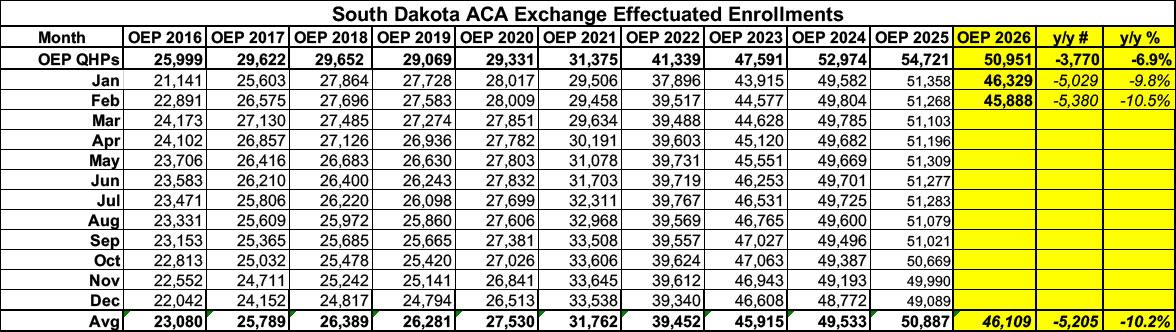
ACA exchangeenrollment has dropped by 10% in South Dakota since Congressional Republicans allowed the enhanced federal subsidies to expire at the end of last year.
Initial signups during Open Enrollment were down7% vs. OEP 2025...but effectuated enrollment was 10.5% lower as of February.
Here's what this looks like visually, with both 2025 and 2019 (the last pre-COVID year, which didn't include the enhanced subsidies) included for comparison:
Initial signups during Open Enrollment were only down about 2% vs. 2025..but effectuated enrollment began to drop immediately and has continued to drop every month since then.
As of June 2026, effectuated enrollment is down 8.4% vs. a year earlier, and is down 7.7% on average for the year so far. That's around 22,000 fewer Coloradans with ACA exchange coverage so far this year:
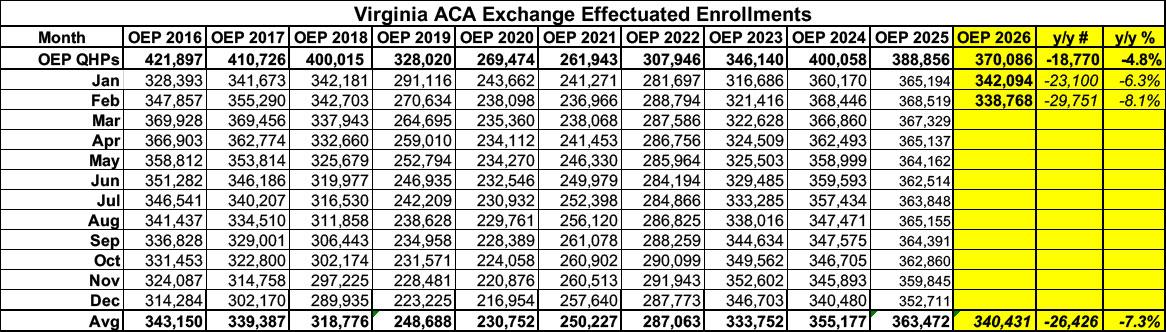
ACA exchangeenrollment has dropped by 8% in Virginia since Congressional Republicans allowed the enhanced federal subsidies to expire at the end of last year.
Initial signups during Open Enrollment were only down ~5% vs. OEP 2025...but effectuated enrollment was down 6.3% year over year as of January and 8.1% as of February.
That's nearly 30,000 Virgnians who lost healthcare coverage in the first two months of the year.
Here's what this looks like visually, with both 2025 and 2019 (the last pre-COVID year, which didn't include the enhanced subsidies) included for comparison:
WASHINGTON—Vice President JD Vance’s antifraud task force is set to remove hundreds of thousands of enrollments from the Affordable Care Act’s public exchanges, saying those enrollees don’t meet eligibility requirements or don’t exist at all.
...Vance and Dr. Mehmet Oz, the administrator for the Centers for Medicare and Medicaid Services, or CMS, are set to announce they are canceling subsidy payments for allegedly unauthorized and fraudulent enrollments in the ACA, also known as Obamacare, for 760,000 individual accounts, according to administration officials. They say those cancellations would amount to saving an estimated $2.2 billion in taxpayer funds.
Before I begin, it's important to note that ACA exchange enrollment has dropped in Pennsylvania since Congressional Republicans allowed the enhanced federal subsidies to expire at the end of last year...although thanks to the state implementing fairly robust Premium Alignment pricing, it's not nearly as dramatic a drop-off as in most other states.
Initial signups during Open Enrollment were actually slightly higher than last year...but effectuated enrollment began to drop starting in February and has continued to drop at an increasing rate every month since then. As of July 2026, effectuated enrollment is down more than 10% vs. a year earlier, and it's down nearly 4% on average for the year so far. That's 48,000 fewer Pennsylvanians with ACA exchange coverage as of July:
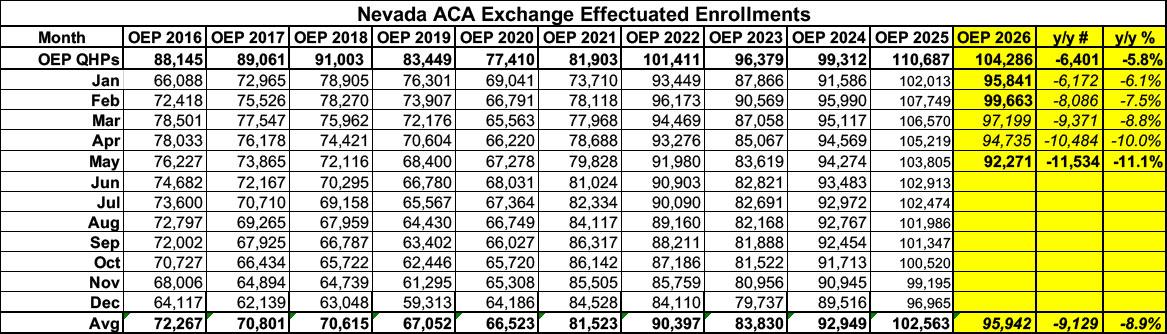
ACA exchange enrollment has dropped by 11% in Nevada since Congressional Republicans allowed the enhanced federal subsidies to expire at the end of last year.
Initial signups during Open Enrollment were only down ~6% vs. OEP 2025...but effectuated enrollment has gradually shrunk further every month since then and stood at 11.1% lower as of May 2026.
That's over 11,000 Nevadans who have lost coverage so far this year.
Here's what this looks like visually, with both 2025 and 2019 (the last pre-COVID year, which didn't include the enhanced subsidies) included for comparison:
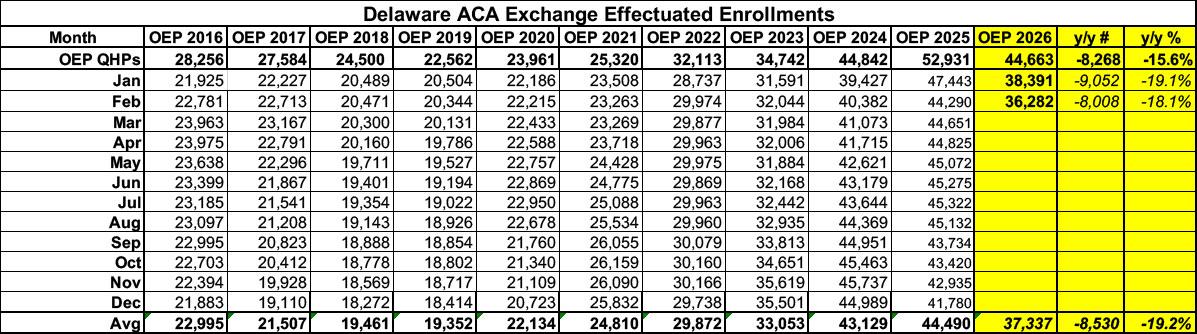
ACA exchange enrollment has dropped by 18% in Delaware since Congressional Republicans allowed the enhanced federal subsidies to expire at the end of last year.
Initial signups during Open Enrollment were already down over 15% vs. OEP 2025...and effectuated enrollment has continued to slip to the point that it was 18% lower in February 2026 than a year earlier.
Here's what this looks like visually, with both 2025 and 2019 (the last pre-COVID year, which didn't include the enhanced subsidies) included for comparison:
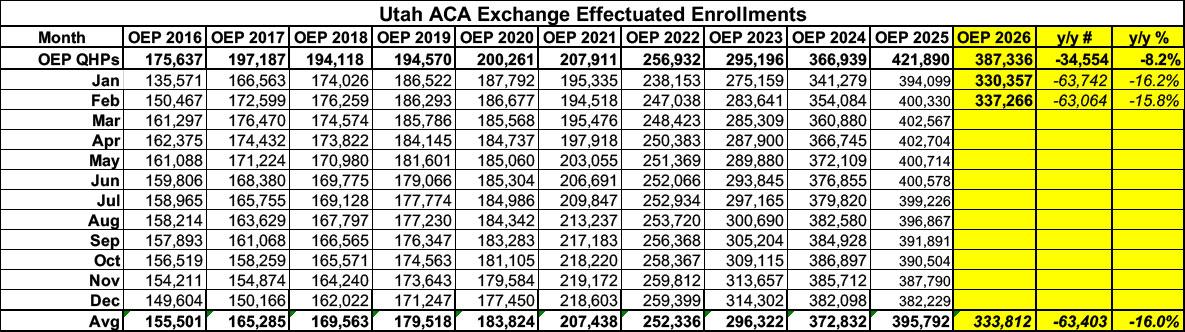
ACA exchange enrollment has dropped by 16% in Utah since Congressional Republicans allowed the enhanced federal subsidies to expire at the end of last year.
Initial signups during Open Enrollment were down 8% vs. OEP 2025...but the drop in effectuated enrollmentdoubled in the first two months of the year, to around 16% lower vs. the same point a year earlier.
That's over 63,000 Utahns who already lost coverage in just the first two months...a number which has likely continued to climb since then.
Here's what this looks like visually, with both 2025 and 2019 (the last pre-COVID year, which didn't include the enhanced subsidies) included for comparison:
Before I begin, it's important to note that ACA exchange enrollment has dropped in Hawaii since Congressional Republicans allowed the enhanced federal subsidies to expire at the end of last year. Fortunately, the raw number of enrollees who have lost coverage is pretty small due to:
a) Hawaii only having around 1.4 million residents to begin with and
b) Hawaii having a much more robust Employer-Sponsored Health Insurance mandate law than the ACA. Under the Hawaii Prepaid Health Care Act of 1974, employers are required to offer coverage to employees working at least 20 hours per week. In contrast, the federal Patient Protection and Affordable Care Act requires employers to offer coverage to employees working at least 30 hours per week.
As a result, Hawaii's individual/nongroup health insurance market is smaller as a percentage of the total population than it is in most other states.
RETURNING BIDEN OVERCHARGES TO WORKING FAMILIES: Today, President Donald J. Trump announced that the federal government will return to the American people hundreds of millions in Obamacare overcharges, collected by the Biden Administration, by issuing refunds of $500 per person to nearly 1 million Americans in 30 states. Today’s actions directly refund the Americans most exposed to the higher costs imposed by the Biden Administration’s gross mismanagement of Obamacare.
So what the hell is this all about? Let's take a look, shall we?
Thirteen health insurers request average 22.4% rate increase for 2027 individual market
OLYMPIA, Wash. — Thirteen health insurance companies have requested an average rate change of 22.4% for Washington state’s 2027 individual health insurance market. Insurers base requested rate changes on assumptions made about the services their policyholders will use and the cost to deliver that care.
“I know the requested rate changes will be difficult for individuals and families,” said Insurance Commissioner Patty Kuderer. “We’re going to spend the next several months reviewing every assumption made by the insurers to make sure their requests are justified.”
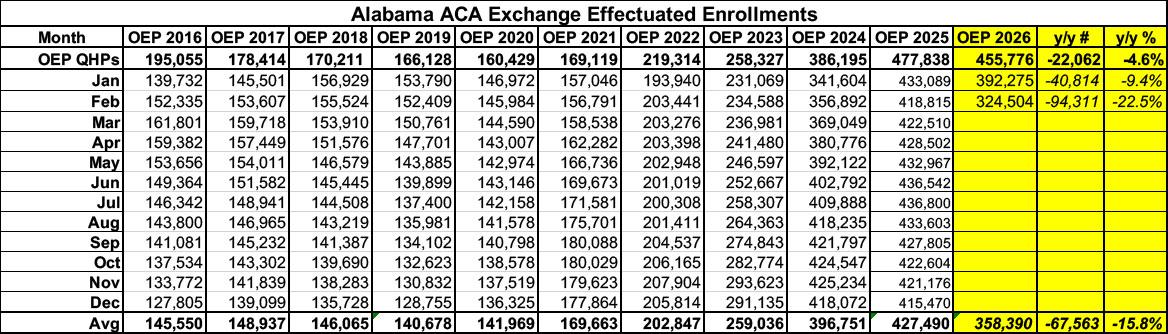
ACA exchange enrollment has dropped by nearly 23% in Alabama since Congressional Republicans allowed the enhanced federal subsidies to expire at the end of last year.
Initial signups during Open Enrollment were already down 4.6% vs. OEP 2025...buteffectuated enrollment as of January 2026 was down over 9% year over year...increasing to a 22.5% drop as of February.
That's over 94,000 Alabamans who already lost coverage in just the first two months of the year...a number which has likely continued to climb since then.
Health insurers must make an application to the Department of Financial Services to evaluate their proposed rate changes. The Department reviews the rate applications along with the insurer’s underlying calculations to make sure that rate increases are justified and not excessive. During review, DFS may request more information from the insurer and consider comments from policyholders or the public. Rate applications and all documents relating to an application can be found here:
Individual and Small Group Medical Premium Rates
Beginning with rate application filings submitted in 2023 for benefit year 2024, rate information will be contained in one place for all insurers, separated by Market Segment.
Thanks to New Mexico backfilling 100% of ALL lost federal tax credits for EVERY ACA exchange enrollee in the state who was eligible for subsidies last year, their average monthly enrollment total is actually higher than it was in 2025 in spite of Congressional Republicans allowing the enhanced federal subsidies to expire at the end of 2025. Initial signups during Open Enrollment were actually up a whopping 18% vs. OEP 2025.
Even so, effectuated enrollment has still gradually declined over the course of the year so far...from 15% higher year over year in January to just 0.5% higher as of July...and this month it actually slipped slightly below the August 2025 tally (New Mexico is one of a handful of states which provide timely, monthly effectuated enrollment data reports).
CONNECTICUT INSURANCE DEPARTMENT RELEASES HEALTH INSURANCE RATE REQUEST FILINGS FOR 2027
The Connecticut Insurance Department (CID) has received rate filings from four health insurers for plans to be offered in the individual and small group markets, both on and off the state-sponsored exchange, Access Health CT . As part of CID’s statutory responsibilities, the CID will conduct a thorough and careful review of each filing to ensure compliance with Connecticut insurance laws and regulations.
The CID’s review process will examine each submission in detail, requiring insurers to provide justifications and supporting evidence for their requested rates. All filings are available on the CID’s website .
The first thing that's important to understand about the Indiana insurance market is that there are two carriers leaving the individual (ACA) market, and one possibly (?) leaving the small group market next year.
In accordance with the provisions of 211 CMR 66.08(3)(e), and in order to ensure that insurance rates are fair to consumers, the Division of Insurance reviews and seeks public comment on the rates requested by health insurance carriers.
The following tables depict the proposed overall weighted average premium increase and the key assumptions behind premium development for the merged (individual and small employer) market filed by insurance carriers as part of the Massachusetts Division of Insurance rate review process (for rates effective in 2027). This information is subject to change as the rate review process continues.
The Health Care Access Bureau within the Massachusetts Division of Insurance is currently reviewing these assumptions. This review process will culminate in a final decision in August 2026.
Merged Market Summary for Proposed Rates Effective for 2027
Yesterday I wrote about the standard monthly Medicaid/CHIP enrollment report published by the Centers for Medicare & Medicaid Services (CMS). I noted that as of April 2026, total combined Medicaid & CHIP enrollment had fallen by another 398,000 people, to around 73.9 million Americans.
I also noted that this figure is nearly 5.1 million lower than it was as of January 2025...the same month that Donald Trump returned to the White House and Republicans took over all three branches of the federal government.
Medicare Advantage (technically "Medicare Part C" & originally called "Medicare+Choice") is a type of health plan in the United States offered by private companies as part of the original Social Security Act of 1965 that created Medicare. It permits a private insurance option that wraps around traditional Medicare. Medicare Advantage plans attempt to fill some coverage gaps and offer alternative coverage options.
Under Part C, Medicare pays a plan operator a fixed payment for each enrollee. The operator then pays for their medical expenses. Traditional Medicare directly compensates providers on a fee-for-service basis. Plans are offered by integrated health delivery systems, labor unions, non profit charities, and health insurance companies, which may limit enrollment to specific groups of people (such as union members).